
The Most Common Traps in Residential Projects
- Bart Kolosowski

- Oct 29, 2025
- 5 min read
Updated: Feb 16

If you’ve designed or managed a high-end residential project anywhere from Chelsea to the Cotswolds, you’ve probably got a catalogue of ‘if only’ stories tucked away ready to unleash.
For the client, it’s the highly personal, multi-million-pound investment in their home. For you, the architect, it’s your reputation and the delicate profit margin on a highly complex commission.
We work with leading practices across London and the South East, and in our work, we witness a whole host of common traps that can eat away at budgets, timelines, and client relationships.
In this blog post, we explore why high-end residential projects often go wrong, and the single most critical lesson to take away from each trap.

THE TRAP OF THE VAGUE BRIEF
A high-end client who says, "I just want something spectacular, a real talking point," sounds like a dream. But as pragmatic advisors, we know this isn’t necessarily the case.
The scenario
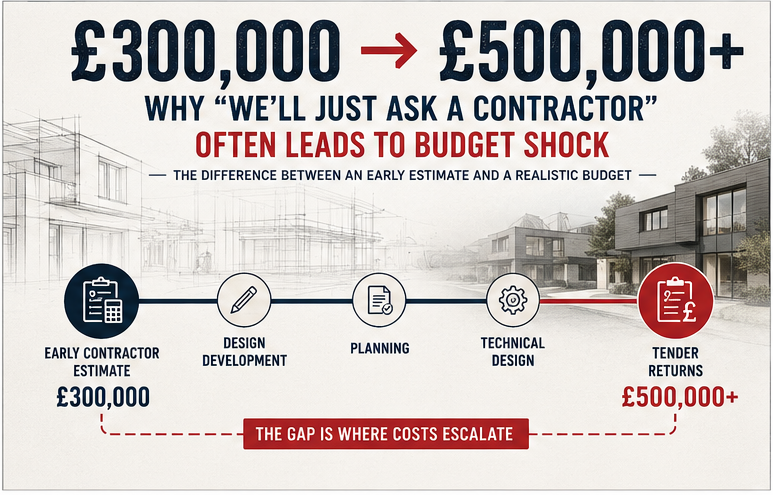
A West London client appointed an architect to design a complete overhaul of their property. The initial brief was peppered with aspirational words such as timeless, luxury, entertaining, but lacked any hard metrics on budget or specific functional needs beyond the basics. The architect, eager to impress, presented a stunning, highly customised design that the client loved until the estimated construction cost came back at £5 million, which turned out to be double of their unspoken budget.
The consequences
The architect had to spend months painstakingly value engineering a design they knew was now compromised, essentially redesigning the project for free while the client felt disillusioned and misled, even though they failed to set a realistic budget. In turn, this massively destroyed momentum and trust on the project.
The lesson
A dream brief without a firmly set, mutually agreed, and evidenced budget isn't actually a brief but rather an expensive wish list.
Your job is simple - make sure that dream is built on a concrete budget from day one. This is because being the voice of reason that insists on early cost control from the offset comes hand in hand with your professional obligation.

THE TRAP OF CHOOSING THE CHEAPEST TEAM
For a client managing a major personal investment, the instinct to save money on consultant fees is understandable. For the architect who recommends them, it’s a failure of professional duty.
The scenario
On a large country house extension, the client insisted on using a Quantity Surveyor whose fees were 40% lower than the architect's recommendation. Their initial cost plan was just a rough estimate on a spreadsheet, missing out crucial details, especially the difficult structural work the design needed. When the real bids arrived, they were £750,000 higher, and the client immediately blamed the design.
The consequences
The architect became the target of the client's fury. They had to spend weeks of unpaid time restructuring the project, trying to rescue the budget, and doing the job of the QS themselves. This led to a six-month delay and a client relationship that never fully healed, simply because they went for the cheapest option first.
The lesson
The quality of the team you build around you is a direct reflection of your own project management competence. Always insist on the best professional grade, not the lowest bid, even if it requires a difficult conversation about initial costs.
You get what you pay for - a low-cost expert will cost you big in the end.

THE TRAP OF IGNORING RISK
In high-end projects, architects, clients, and contractors are often victims of their own optimism. The good news is that we focus on the perfect finished article, not the nasty surprises lurking in the ground or behind a wall.
The scenario
A refurbishment of a grand Victorian property started on site with an aggressive, fast-track programme. Everyone assumed the existing structure was sound, however, two weeks in, the contractor discovered a foundation issue as well as an unrecorded, asbestos-laced basement ceiling. As a result, their four weeks of backup time was used up in just ten days. This could have been avoided if they’d had a detailed risk plan in place.
In my work, we often see this failure to properly ringfence contingency funds. The money is there, but no one wants to admit they might have to use it.
The consequences
The client had to immediately find an extra £200,000 from their furniture budget and the programme was extended by two months. The project shifted from a controlled construction process to an endless series of crisis meetings, completely eroding the financial buffer and trust.
The lesson
Risk management is not a tick-box exercise but rather a critical project discipline. Before starting any project, identify the top 10 risks (e.g., ground conditions, party wall awards, existing structure issues), assign a probability and a cost, and ringfence a specific contingency to address them if needed.
Wishful thinking won't save your project - a solid risk plan will.

THE TRAP OF LOWEST TENDER WINS
The lowest tender is statistically the highest risk. Yet the temptation, and client pressure, to appoint the cheapest contractor is immense.
The scenario
A £3 million build was tendered to five firms. The winning bid was £400,000 below the average of the other four experienced, high-end contractors. The client insisted on appointing them, going against the architect's advice. The contractor's low price was a cash-flow play, based on under-resourcing the project and using cheap subcontractors.
This is a classic challenger situation we address weekly: you must confront the false economy.
The consequences
The quality of the fit-out was immediately below standard and the contractor made aggressive and often baseless claims for payment, time, and variations to boost their margins back up. The final 20% of the project became a legal dispute, the client paid nearly £500,000 in legal fees and dispute resolution costs, and the project was finished 12 months late by a replacement contractor. The savings were an illusion.
The lesson
When picking a contractor, it’s important to look at their ability, history, financial strength, and willingness to partner with the team. A contractor who prices the job too low is either not good at their job or plans to make up the money later by hitting you with extra charges and arguments.
The cost of a dispute always outweighs the low-tender saving.
CONCLUSION: THE PATH TO CONTROL
These traps are the root cause of nearly all stress, budget blowouts, and client unhappiness in high-end projects.
The good news? They’re all avoidable. They aren't mistakes in your well thought out designs but they are structural failures in the project's foundation. We help practices such as yours to build the control and clarity needed to navigate this complex world.
If you're tired of redesigning for free or spending months mitigating avoidable risks, let us provide the pragmatic foundation you need.
Get in touch today for an example of our complete cost-planning framework, or share this with a colleague who needs to be the voice of reason on their next commission.


Comments