
Why Contractor Quotes Need a Common Pricing Document
There are two appointments that shape the outcome of a residential construction project more than almost anything else. The first is the appointment of the design team, because that determines what is designed, how well the project is coordinated and whether the brief is translated into something that can actually be built. The second is the appointment of the contractor, because that decision has an enormous influence over how the project is delivered, how the programme is managed, what the final quality looks like and, very often, how much the project ultimately costs.
In commercial terms, the appointment of the contractor can easily have the greater influence on the final result. A capable contractor can manage complexity, coordinate trades, anticipate problems and keep a difficult project moving, while the wrong contractor can undermine a good design, create constant disputes and turn every unresolved detail into a claim for additional money.
Considering the importance of that decision, it is surprising how casually it is sometimes approached. Contractors are sent a set of drawings, asked to provide a quote and, once three or four prices are returned, the client assumes they have a meaningful basis on which to choose between them.
The difficulty is that the contractors may not have priced the same project at all.
Without a common pricing document, each contractor is left to decide how to structure the quotation, what should be included, how gaps in the design should be treated and which risks should be allowed for. The result may be three quotations, but those quotations can represent three different interpretations of what the project actually involves.

The False Comfort of Three Prices
Consider a typical residential refurbishment and extension where the returned quotations are as follows:
Contractor A: £425,000
Contractor B: £475,000
Contractor C: £520,000
At first glance, the client appears to have a £95,000 spread and a relatively straightforward decision to make. Contractor A looks substantially cheaper, Contractor C appears expensive and Contractor B may seem like the sensible middle option.
The problem is that none of those conclusions can be reached until the scope behind each figure has been understood.
One contractor may have included all of the structural work shown on the engineer’s drawings, including temporary works and specialist connections, while another has allowed for the steelwork itself but excluded the temporary works needed to install it. One may have included full redecoration throughout the house, while another has allowed only for the new extension and directly affected areas. One may have included external drainage alterations, while another has inserted a provisional sum and the third has assumed that the existing drainage can be reused.
The same differences may exist in relation to windows, joinery, sanitaryware, services, floor finishes, landscaping and making good. The £95,000 difference between the lowest and highest quotation may therefore be partly a genuine difference in contractor pricing, but it may also be a difference in scope, specification, assumptions and risk.
Until those differences are identified, the client does not really have three competing prices. They have three different versions of the project.
A Contractor Can Only Price the Information Provided
A contractor’s quotation is an answer to the information they have received and, where that information is incomplete, to the assumptions they have chosen to make.
Different contractors will deal with uncertainty in different ways. One may make what they consider to be a reasonable allowance in order to produce a relatively complete price. Another may exclude anything that is not fully designed. A third may insert provisional sums, while another may assume a lower specification in order to keep the initial quotation competitive.
Some contractors will take a cautious approach and allow for risks they consider likely to arise. Others will submit a leaner initial quotation and expect unresolved items to be dealt with later through variations. Some will explain their assumptions clearly, while others will provide a short quotation in which it is difficult to establish whether an item has been included, omitted or simply overlooked.
This does not automatically mean that anyone is acting improperly. Every construction project contains uncertainty, particularly refurbishment projects where existing buildings conceal surprises and parts of the design continue to develop.
The issue is not that uncertainty exists. The issue is allowing each contractor to treat the same uncertainty differently, without making those differences visible.
Once that happens, the quotations stop being different prices for the same project and become different commercial interpretations of it. The lowest quotation may still represent the best price, but it may also be lower simply because less has been included.
What a Common Pricing Document Actually Means
A common pricing document does not necessarily mean a detailed Bill of Quantities.
The appropriate level of detail depends on the nature and complexity of the work. For a small and straightforward project, it may be a structured schedule dividing the work into clear packages and requiring each contractor to provide a price against the same headings. For a more substantial refurbishment or extension, a Schedule of Works will usually be more appropriate. For larger or more complex projects, a Bill of Quantities may be justified.
The value of the project is relevant, but complexity often matters more. A relatively expensive window replacement package may be capable of being priced through a simple schedule, while a smaller refurbishment involving structural alterations, services upgrades and extensive making good may require considerably more detail.
What matters is that one common document tells every contractor how the price should be structured, what each section is intended to cover, how known gaps and risks should be treated, where provisional sums are required and how exclusions, qualifications and alternatives should be identified.
The pricing document does not replace the drawings or specification, and it does not price the work on behalf of the contractor. Its purpose is to establish the common commercial basis on which each contractor prepares their own price.
Without that structure, every contractor creates their own pricing document. One may divide the project by trade, another by floor and another by construction phase. Even where all three have included broadly the same work, it becomes much harder to identify whether an apparent difference relates to price, scope or simply the way the quotation has been organised.

Managing Uncertainty Rather Than Pretending It Does Not Exist
One of the most important functions of a pricing document is not to eliminate uncertainty, but to control how that uncertainty is treated.
Below-ground drainage is a simple example. On many refurbishment and extension projects, the precise route and condition of the existing drainage cannot be fully established before excavation begins. It may therefore be impossible for a contractor to provide a completely fixed price for all of the work that might eventually be required.
That does not mean the issue should simply be left open.
A pricing document can instruct every contractor to include the same provisional sum for undefined drainage work, while separately pricing the elements that can be established from the drawings. Without that direction, one contractor may allow £5,000, another £20,000, one may exclude the work entirely and another may assume that no significant alterations will be necessary.
The resulting quotation totals will appear different, but the difference may have little to do with contractor competitiveness. It may simply reflect four different approaches to the same unknown.
The same principle applies to opening up existing structures, hidden defects, service upgrades, asbestos, specialist design and many other common risks. Where the precise work cannot be fixed, the basis of the allowance can still be standardised.
A good pricing document does not create false certainty. It makes uncertainty visible and ensures that all contractors deal with it on a comparable basis.
What Happens When There Is No Common Pricing Document
When contractors are asked to prepare their own quotations without a common structure, the client usually receives documents that bear very little resemblance to one another.
One contractor may provide a detailed 25-page breakdown. Another may submit three pages and a total. A third may divide the work by trade, while the next divides it by floor or construction phase. Each quotation may contain different scope headings, specifications, provisional sums, qualifications and exclusions.
The difficulty is not limited to items that are expressly excluded. Something may simply be absent from the quotation, leaving no clear indication of whether it has been omitted, included elsewhere or considered unnecessary.
To compare those quotations properly, someone then has to reconstruct each contractor’s understanding of the project. That normally involves breaking the quotations into a common structure, checking them against the drawings and specifications, identifying omissions and possible duplication, reconciling provisional sums, reviewing qualifications, issuing clarification questions and obtaining revised prices.
It can be done, and we are regularly asked to do exactly this. The difficulty is that the work is slow, expensive and less reliable than issuing a common pricing document before the contractors begin pricing.
The client is then left with two choices. They can pay for the quotations to be properly reconstructed and clarified, or they can select a contractor without fully understanding what each quotation includes.
The second option appears cheaper only because the uncertainty has been carried forward into the construction stage.
What a Like-for-Like Comparison Really Looks Like
A like-for-like comparison does not mean that every contractor will return an identical quotation.
Even where all contractors price the same document, there will still be differences. One may qualify an item, another may propose an alternative specification, one may exclude part of the work, and another may identify a design risk that the others have missed. Contractors will also have different labour rates, supply chains, overheads, methods and attitudes towards risk.
The purpose of a common pricing document is not to remove those differences. It is to make them visible.
Where the same schedule has been priced by each contractor, the returns can be placed alongside one another. Individual work packages or items can be compared, significant differences can be questioned, and omissions, qualifications and residual risks can be listed separately. The tender totals can then be adjusted onto a broadly common basis.
This allows the client to understand whether one contractor is genuinely cheaper, whether their price is lower because something has been excluded or whether they have simply taken a different view of a particular risk.
A comparison is rarely perfectly like-for-like. The important point is that the differences can be identified, measured and taken into account before the appointment is made.

The Problem Does Not End When the Contractor Is Appointed
Where the scope was unclear during pricing, it will usually remain unclear during construction.
The contractor may believe that an item was excluded because it did not appear in their quotation, while the architect or client may believe it was included because it was shown somewhere on the drawings. The contractor may have priced one specification while the client expected another, or a provisional sum may prove inadequate once the work is opened up.
Without a clear pricing document and tender record, it becomes difficult to establish what was actually included in the accepted contract sum. This leads to claims for additional money, disputes over scope, difficulty assessing variations and increasing pressure on the relationship between the contractor, client and design team.
What is then described as a contractor problem or a cost-control failure may have started much earlier. The commercial scope was never properly established before the contractor was appointed.
When Informal Quotations Are Perfectly Reasonable
Not every project needs a detailed Schedule of Works or Bill of Quantities.
A clearly defined window replacement package, bathroom refurbishment, boiler installation or straightforward repair may be capable of being priced through a relatively simple quotation process. Even then, the client still needs to confirm the specification, associated works, exclusions and responsibility for making good.
The issue is one of proportionality.
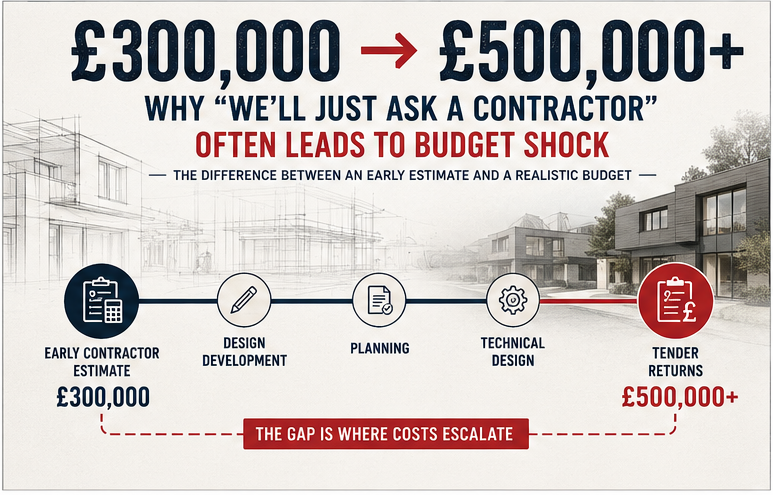
The more trades, interfaces, structural alterations, design assumptions and existing-building risks involved, the less sensible it becomes to allow each contractor to create their own pricing structure. A straightforward bathroom replacement may be easy to define in a few pages. A £500,000 refurbishment involving structural work, services, retained finishes, joinery and external works requires a more structured approach.
The purpose of the pricing document is not to create paperwork for its own sake. It is to make the quotations useful.
The False Economy of Doing the Work Backwards
On a typical residential project of approximately £500,000, we might charge around £2,000 to prepare an appropriate Schedule of Works and a further £600 to £1,000 to analyse the returned tenders. Allowing for meetings, queries and revisions, the total may be around £3,000.
If three unrelated contractor quotations have already been obtained and need to be reconstructed, checked, clarified and renegotiated, the same exercise may instead cost £5,000 or £5,500.
The additional cost is not due to the project becoming more complicated. It is because the commercial work is being carried out backwards.
Even the higher figure represents roughly 1% of a £500,000 construction budget. One misunderstood package, a significant omission, or a disputed variation can easily exceed that amount on its own.
The argument is not that every client must employ a quantity surveyor or that every project requires an elaborate tender process. It is that deciding how to spend £500,000 based on quotations that cannot be properly compared is a poor place to economise.

Choosing the Contractor, Not Merely the Number
The purpose of obtaining several contractor quotations is not simply to generate several totals. It is to create meaningful competition and allow the client to make an informed choice between competing contractors.
That requires an understanding of what each contractor has priced, what they have excluded, what assumptions they have made and how the remaining risks have been treated.
A common pricing document creates the commercial baseline needed to make that assessment. It does not eliminate every gap in the design, force every contractor to approach the project in the same way or guarantee that the lowest quotation will be the right appointment.
It makes the differences visible.
Without it, the client may still have three quotations, but they do not necessarily have three comparable offers.


Comments