
The 50% Disconnect: Why Residential Project Budgets Fail the Feasibility Test
- Jun 3
- 5 min read

Over the past 12 to 18 months, a clear pattern has emerged in conversations with private clients. When describing the vision for their home—the scope, the structural changes, the level of finish—there is a predictable moment on the call. Before they even reveal their budget, it is often possible to guess the number in their head.
"More often than not, that number is exactly half of what the project actually needs."
This isn’t a national statistic; it is a trend recognised immediately by architects, cost consultants, and design teams across the industry. Homeowners are not trying to be difficult or unrealistic. Rather, they are attempting to make sense of an expensive, fast-moving target using outdated reference points and partial information.
To build a successful project, we have to understand exactly why this budget disconnect happens.
1. The Timeline Trap: Understanding the Telescoping Effect
When a client proposes a budget figure, it rarely comes out of thin air. Usually, it is linked to a real-world example: a neighbour’s kitchen extension, a brother-in-law’s refurbishment, or a project they completed themselves "a few years back."
While referencing past projects seems sensible, human memory is actually quite poor when it comes to tracking time. Psychologists call this the telescoping effect—our tendency to remember past events as happening much more recently than they really did.
When asked to count backwards, a client who insists a project happened "a couple of years ago" will frequently realise it actually took place in 2016 or 2017. Because the pandemic disrupted our sense of time, anything pre-COVID feels like yesterday. Unfortunately, a budget from 2016 reflects a completely different economic reality.
2. The Psychology of Price Anchoring in Construction
Once a number gets into a client's mind, it becomes incredibly hard to shift. This is known as anchoring. If a homeowner remembers a friend completing a major extension for £250,000, that quarter-of-a-million figure becomes the benchmark against which all future construction costs are judged.
The issue is that the anchor stays fixed while everything else—labour, materials, and regulations—is moving upwards. Instead of building a budget from scratch based on today’s market, clients often try to adjust their old anchor point, and they rarely adjust it anywhere near enough.
3. The Hard Data: UK Construction Inflation Since 2015
To bridge the gap between memory and reality, we have to look at how much the market has actually moved. According to official data from the Office for National Statistics (ONS), housing construction costs have risen significantly, sitting around 55% higher than their 2015 baseline.

A project costing £250,000 a decade ago automatically starts at nearly £390,000 today before a single wall is moved or a specification is changed. When you add professional fees, VAT, structural contingency, and design development, the "half-the-budget" mystery quickly dissolves into pure maths.
4. Today’s Home is a Different Technical Product
Inflation tells only part of the story. The residential project being delivered today is fundamentally different from the one built ten years ago. Modern building standards demand much higher performance. Energy efficiency rules are tougher, insulation depths have increased, and overheating risks must be formally calculated.
Client expectations have also changed. Homeowners are rarely looking for a basic, standard extension. Modern briefs consistently demand ultra-slim frame glazing, seamless indoor-outdoor floor levels, underfloor heating, and smart lighting. You are often trying to buy a high-performance architectural product using a budget memory tied to a basic build from a decade ago.

5. The Big Shift in the UK Labour Market
While material price spikes capture headlines, labour availability is the quiet driver of modern project feasibility. The construction industry continues to face severe shortages of skilled workers. This pressure is felt particularly hard in the private residential sector, which relies on small-to-medium enterprises and local trades.
In areas like London and the South East, the labour pool has shrunk significantly. When skilled labour is hard to find, the dynamic flips: contractors become selective and price risk properly into their quotes. They will walk away from unclear drawings or high-risk sites where the budget doesn't make sense.
Core Drivers of Modern Project Costs
6. Budget Limits vs. True Affordability
Sometimes when a client says their budget is £400,000, they aren't offering a market-tested estimate—they are stating their affordability ceiling. With borrowing costs and interest rates remaining tight, stretching a budget through financing is far more difficult than it used to be. Initial budgets are often based on financial comfort zones rather than the physical realities of the market.
7. Why This Matters So Early in the Design Process
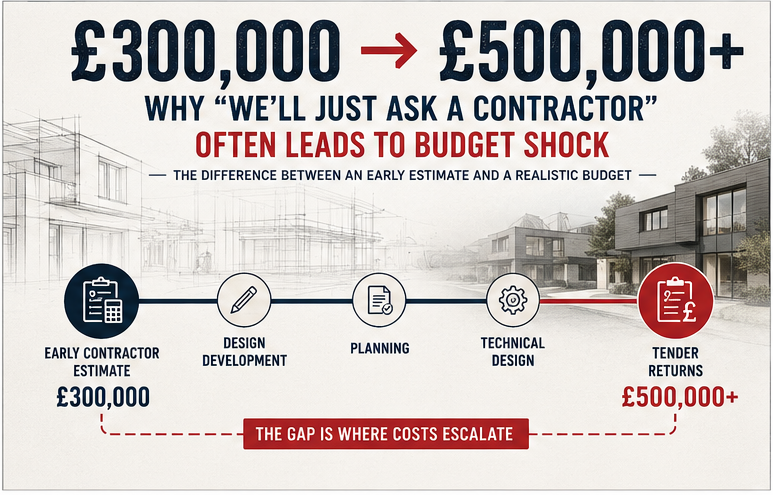
The reason this matters is that the budget conversation often happens far too late. By the time proper cost advice is brought in, the client may already be emotionally attached to the design. Planning may have been submitted, and the architect may have spent months developing a scheme.
At that point, finding out the real budget is nowhere near the assumed budget is painful for everyone. The client feels disappointed, the architect has to redesign, the QS looks like the person bringing bad news, and the contractor is accused of being expensive. Often the issue was there from the beginning—it just was not tested early enough.
8. No Single Answer, But a Clear Pattern
The more you look at this problem, the clearer it becomes that there is no single, simple reason. It is the combination of everything:
Construction costs have jumped significantly.
We remember past projects as being much more recent than they actually were.
Old numbers stick in our minds as anchors.
Building standards and energy regulations have moved on.
Skilled trades are much harder to find and secure.
Design expectations have risen.
Borrowing money is tighter and more expensive.
Initial budgets are often based on what people can afford rather than what the build actually costs.

Individually, none of these points explain why initial budgets are so often half of what is needed. But when you stack them together, the pattern makes perfect sense.
If a client is thinking of a project completed eight or ten years ago, remembering the price but forgetting the context, and trying to apply that number to a far more ambitious design, in a tough labour market, under strict modern regulations, with higher standards and tighter borrowing conditions—then the "half-the-budget" problem is not surprising at all.
In fact, it is exactly what we should expect.
The Feasibility Fix: Stress-Testing Day One
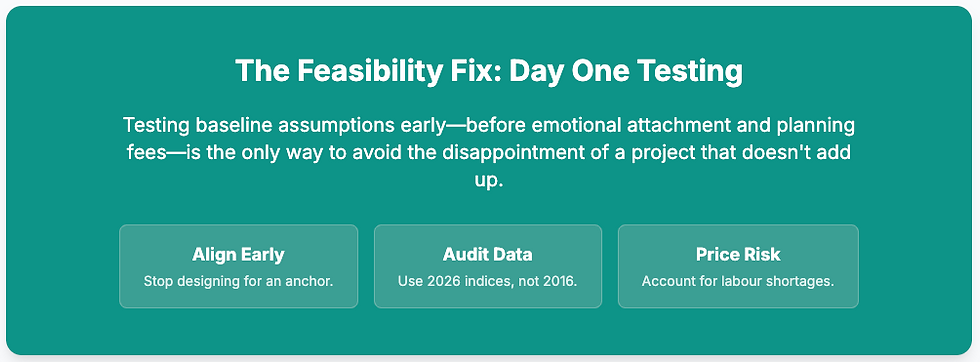
This is why early cost alignment is the most critical phase of any project.
It is not because every client needs a full cost consultancy service from day one. And it is certainly not about stripping away ambition or cutting a design to pieces before it has even started.
It is simply about testing the baseline assumptions early enough, before everyone spends months developing a project around a budget that was never realistic in the first place.
I would be very interested to know if other architects, designers, builders, and consultants are seeing the same pattern.
Are your clients increasingly arriving with budgets that feel completely detached from the spaces they want to build? Or am I just noticing it more because I spend too much time talking about cost?


Comments